

The Dock arrived with the Aqua desktop as one of Mac OS X’s defining features, carrying forward ideas from NeXT’s launcher while giving applications, documents, and minimized windows a shared home. Its polished surface concealed a useful detail: much of the Dock’s behavior lived in the com.apple.dock preferences domain.
That domain reaches beyond the controls exposed in System Preferences. The defaults command can change its tile arrays, screen position, alignment, animation, and magnification settings. When customizing the Dock on systems from OS X 10.4 through 10.6, I use a strict cycle: write one preference, restart the Dock, inspect the desktop, and record the matching delete command. This keeps experimentation controlled and makes each change reversible.
One-Key Discipline
Change one key at a time while learning the domain. A batch becomes sensible only after every command and its reversal have been checked individually.
Back Up com.apple.dock Before the First Edit
The user-level preference file sits at ~/Library/Preferences/com.apple.dock.plist. Older Mac OS X releases do not all handle preference files identically, and a background configuration daemon may retain cached values while the Dock is running. Copying the file remains useful, but a second plain-text record gives you a readable reference if the binary property list is locked or replaced.
Keep Two Dated Records
Leave the original file in place. Open Terminal and create a dated copy, replacing YYYY-MM-DD with the current date:
cp ~/Library/Preferences/com.apple.dock.plist \ ~/Desktop/com.apple.dock.plist.YYYY-MM-DD.backupThen capture the domain as text:
defaults read com.apple.dock \ > ~/Desktop/com.apple.dock.YYYY-MM-DD.txtThe raw copy is the recovery asset. Treat the text file as your working map: it lets you check previous values, array contents, and key names without modifying anything.
Understand the Three Core Commands
- defaults write com.apple.dock key value creates or changes a key.
- defaults delete com.apple.dock key-name removes a custom key from the domain.
- killall Dock ends the current Dock process so Mac OS X can relaunch it and reread preferences.
Apple's archived defaults manual documents the command syntax. These examples cover behavior tested across OS X 10.4 through 10.6; individual point releases may ignore release-sensitive hidden keys.
Divide Dock Tiles with Stable Spacer Entries
Spacer tiles create visual groups without changing application icons or installing classic OS X utilities. The Dock stores application-side items in persistent-apps. Documents, folders, and Trash occupy the persistent-others side.
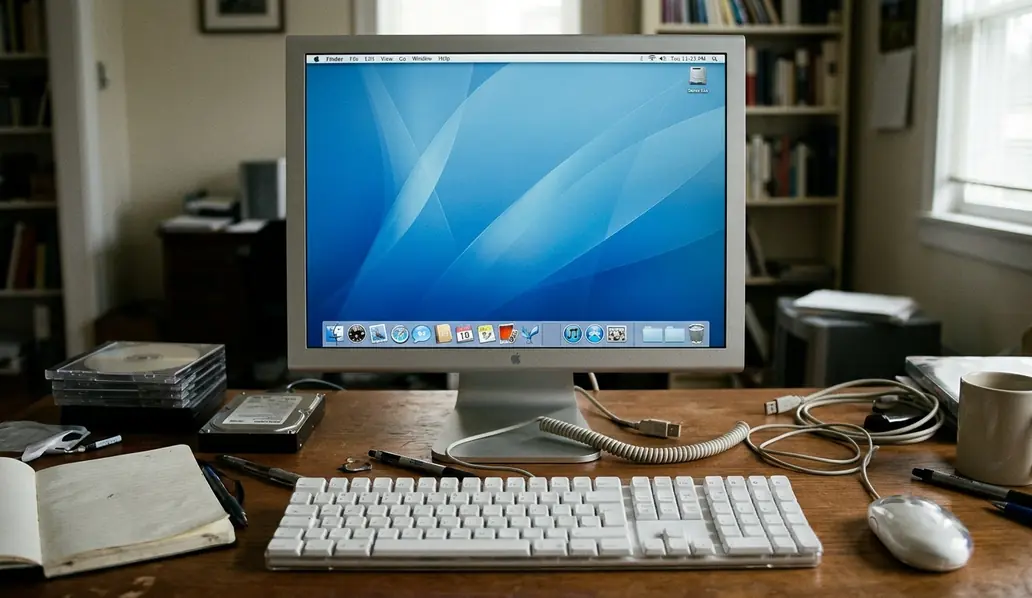
Add an Application-Side Spacer
defaults write com.apple.dock persistent-apps -array-add \ '{tile-data={}; tile-type="spacer-tile";}' killall DockThe dictionary supplies an empty tile-data entry and identifies the new item as a spacer-tile. Each execution appends another spacer, so run it only as many times as needed.
Add a Folder-Side Spacer
defaults write com.apple.dock persistent-others -array-add \ '{tile-data={}; tile-type="spacer-tile";}' killall DockAfter relaunch, drag a spacer within its side of the Dock just as you would reposition an icon. Drag it away from the Dock to remove it. This field manual stays with the standard spacer dictionary because half-height and other alternative tile forms behave inconsistently across classic releases.
Spacer Count Check
Run all required array additions before one killall Dock. Repeating the command while troubleshooting often leaves extra blank tiles that are easy to overlook on a crowded Dock.
Place and Pin the Dock Along One Screen Edge
A bottom Dock suits the original Aqua layout. On an older widescreen display, moving it to the left or right can return valuable vertical space to document windows.
The orientation key accepts bottom, left, or right. This example moves the Dock left:
defaults write com.apple.dock orientation -string left killall DockIts matching reversal removes the override and lets the release supply its normal value:
defaults delete com.apple.dock orientation killall DockAlign the Dock Within Its Edge
The pinning values are start, middle, and end. They control alignment along the selected edge, and nothing more: no monitor selection, no move to a different edge.
defaults write com.apple.dock pinning -string start killall DockReverse that alignment change with:
defaults delete com.apple.dock pinning killall DockSecondary-display arrangements deserve a visual check immediately after each write. Keeping the delete command beside the write command avoids prolonged off-screen placement loops.
Coordinate Tile Size, Magnification, and Motion
Three keys work together: tilesize sets the base icon size, magnification enables enlargement under the pointer, and largesize sets the enlarged size. Choose whole-number values suited to the display, with <MAGNIFIED_SIZE> meaningfully larger than <BASE_SIZE>.
defaults write com.apple.dock tilesize -int <BASE_SIZE> defaults write com.apple.dock magnification -bool true defaults write com.apple.dock largesize -int <MAGNIFIED_SIZE> killall DockInspect icon legibility at rest, then sweep the pointer across several adjacent tiles. Excessive enlargement makes neighboring applications harder to target, especially when the Dock holds a long row of similar icons.
Keep Minimize Effects Conservative
The established mineffect values are genie and scale:
defaults write com.apple.dock mineffect -string scale killall DockAn undocumented “suck” effect was considered for this manual and rejected after visual tearing appeared on older graphics hardware. Stable genie and scale motion better suits a restoration-focused setup.
Treat Autohide Timing as Release-Sensitive
The visible autohide preference is straightforward, while hidden delay and transition-duration keys vary by release. Unsupported keys may simply be ignored. Extreme timing values can also make the Dock appear missing or unresponsive, which complicates diagnosis because the process itself may still be healthy.
Set autohide through the visible preference pane first. Experiment with hidden timing only after backing up the domain and preparing the exact delete command for the key being tested.
Recover the Dock One Key at a Time
When a change behaves badly, begin with the most recently edited key. Delete that key, restart the Dock, and inspect the result. Removing an override is safer than writing a guessed factory value because Apple’s defaults can differ between OS X releases.
- Run defaults delete com.apple.dock key-name for the latest change.
- Run killall Dock.
- Restore the dated preference-file copy if targeted deletion does not recover the layout.
- Use a domain-wide reset only when the configuration is genuinely unusable.
Full Reset Blast Radius
defaults delete com.apple.dock removes the entire Dock preference domain. It can erase application order, custom folder tiles, spacers, orientation, alignment, and other personalized state. The workspace may require a complete manual rebuild after the Dock restarts.
defaults delete com.apple.dock killall Dock
The recovery ladder protects the parts of the layout that still work. Domain-wide deletion belongs at the bottom of that ladder.
Apply a Reversible Left-Side Dock in One Pass
This final sequence creates a restrained setup: it records the current domain, moves the Dock left, enables moderate magnification using sizes selected for the display, adds one application-side spacer, and relaunches the process once.
defaults read com.apple.dock \ > ~/Desktop/com.apple.dock-before-left-setup.txt defaults write com.apple.dock orientation -string left defaults write com.apple.dock magnification -bool true defaults write com.apple.dock tilesize -int <BASE_SIZE> defaults write com.apple.dock largesize -int <MAGNIFIED_SIZE> defaults write com.apple.dock persistent-apps -array-add \ '{tile-data={}; tile-type="spacer-tile";}' killall DockAfter relaunch, check the left edge first. Confirm the Dock’s alignment, locate the spacer among the application tiles, compare the resting and magnified icon sizes, and minimize one window to judge the animation feel.
Reverse Only What the Recipe Changed
defaults delete com.apple.dock orientation defaults delete com.apple.dock magnification defaults delete com.apple.dock tilesize defaults delete com.apple.dock largesize killall DockRemove the spacer by dragging it out of the Dock. That preserves application order and folder tiles while undoing the visible setup.
Keep the dated backup on the Desktop, delete one key at a time when something looks wrong, and reserve defaults delete com.apple.dock for a Dock that can no longer be repaired selectively.








Discussion
Share your thoughts.
Write a Comment